During the NRR 2026 Congress in Delft, Jouke Boorsma of AquaMinerals presented the lessons learned from more than ten years of practical experience with struvite recovery in the Netherlands. The presentation attracted considerable interest, as phosphorus recovery is increasingly gaining attention from water authorities, governments and market participants.
The main conclusion was clear: struvite recovery has proven itself in practice, yet the available potential is still far from being fully utilised.
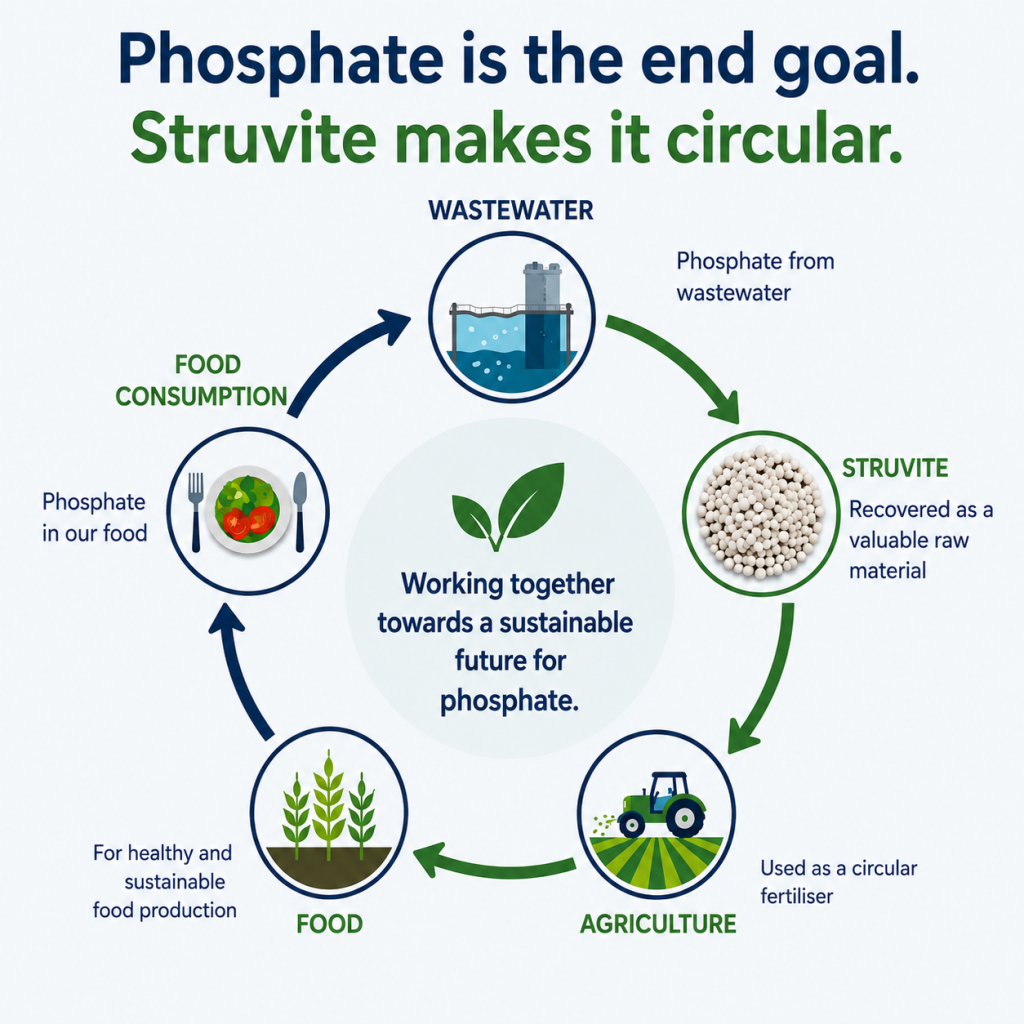
Interest in phosphorus recovery is growing not only because of circular economy ambitions. Phosphate is an essential raw material for global food production, and its availability is largely determined by a limited number of countries. As a result, security of supply and geopolitical dependencies are becoming increasingly important alongside sustainability considerations. Struvite offers the opportunity to recover phosphate from wastewater and make it available again as a valuable raw material. In doing so, it contributes to a circular economy, reduces CO₂ emissions and strengthens Europe’s resource security.
In discussions on phosphorus recovery, it is sometimes suggested that a choice must be made between struvite recovery and future phosphate recovery from sewage sludge ash. In practice, however, these approaches complement one another. Struvite enables part of the phosphate to be recovered early in the treatment process, while ash-based recovery routes focus on the phosphate remaining after sludge treatment. By developing both routes in parallel, total phosphorus recovery can be maximised.
An important outcome of the analysis presented is that the main challenge is no longer technical in nature. The Netherlands now has several full-scale struvite recovery installations, yet a significant share of the available capacity remains unused. Improvements in process operation, asset management and operational focus can substantially increase production at existing facilities.
At the same time, standardisation remains an important point of attention. As more installations are commissioned, the need for a uniform product with predictable characteristics and consistent quality continues to grow. This increases confidence among end users and strengthens the market position of struvite as a secondary raw material.
Another common assumption is that there is insufficient market demand for struvite. AquaMinerals’ experience demonstrates the opposite. Struvite has achieved End-of-Waste status in the Netherlands and has successfully found its way to end users for many years. Demand for circular phosphate-based raw materials exists; the main challenge lies in achieving sufficient, reliable and consistent production.
Thanks to its long-standing involvement with both producers and end users, AquaMinerals fulfils a unique role between water authorities and market participants. This position enables practical experience to be translated into market development and vice versa. In this way, AquaMinerals makes an important contribution to the further development of a robust and circular phosphorus value chain.
Interested in the presentation? Download it here.